
Inventory & Procurement
Purchase order receiving workflow: from supplier intent to warehouse truth
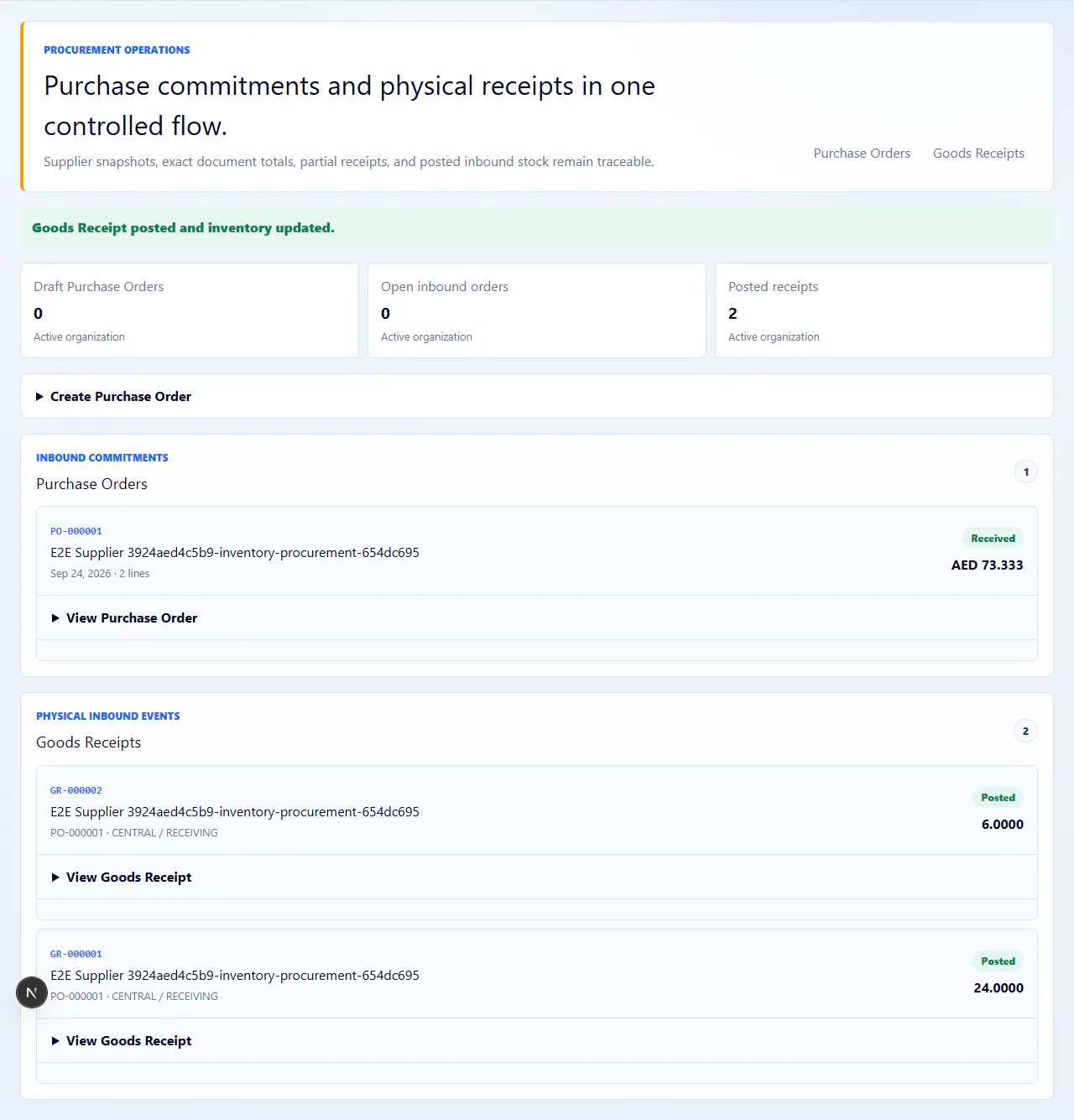
A purchase order records what the business intends to buy. A goods receipt records what the warehouse accepted. Keeping those events separate makes both procurement and inventory more trustworthy.
Reader intent: Informational procurement workflow evaluation
01
Why a purchase order should not increase stock
The order expresses a commitment to a supplier, not proof that goods exist in the warehouse. Increasing on-hand quantity when the order is created makes inventory optimistic and hides delivery differences. The receiving event should be the point where accepted physical quantity becomes an attributable inbound movement.
This separation also supports partial delivery. The business may order ten units and receive six today. The order can retain the remaining commitment while the receipt records only the six accepted units. A later receipt can handle the balance without rewriting the earlier warehouse event.
02
Define the documents and owners
Procurement owns supplier choice, commercial terms, requested items, quantities, destination, and the purchase-order lifecycle. Warehouse receiving owns the physical confirmation of what arrived and where it was accepted. Finance may later use the order and receipt as context for payable processing, but should not be forced to infer receiving truth from an invoice alone.
Each record needs an identity, actor, time, status, and source relationship. Approval should be explicit where the organization requires it. Receiving should reference an order line rather than accepting unrelated free text. Corrections need a controlled path so history remains visible.
| Record | Owner question | Must not imply |
|---|---|---|
| Purchase order | What did we authorize? | That goods arrived |
| Goods receipt | What did we accept? | That supplier payment is complete |
| Inventory movement | What quantity changed where? | That every financial condition is satisfied |
| Payable record | What do we owe and why? | That warehouse quantity was never disputed |
03
Receiving steps that preserve evidence
Select the source purchase order, confirm the destination warehouse and location, and record received quantity by line. Validate that the item identity and unit match the order. If damaged or rejected quantity must be tracked, use a defined status or exception process rather than adding it to available stock and explaining it later in notes.
Completion should create one goods-receipt result and one set of corresponding movements. Replaying the request must not create duplicate stock. Concurrent receipt attempts against the same order need an authoritative response, especially when the remaining quantity is limited.
- Reference the approved source order and exact line.
- Record accepted quantity, unit, warehouse, and location.
- Keep partial receipt and remaining order quantity visible.
- Prevent duplicate completion and excess receipt where required.
- Retain actor, time, and movement source in audit history.
04
Reconciliation and exception review
Review orders that remain open long after expected delivery, receipts above ordered quantity, receipts without a current destination, and stock movements without a valid source. The useful report links the commercial commitment, physical acceptance, and resulting quantity rather than presenting three unrelated totals.
When a mistake occurs, prefer a controlled correction or reversal that preserves prior evidence. Deleting a receipt after downstream movement or financial work has begun may make the current screen look clean while destroying the explanation for historical balances.
05
How Zivanox bounds the workflow
Zivanox connects supplier records, purchase orders, goods receipts, warehouse locations, and inventory movement inside one organization context. Permissions and audit history remain attached to purchasing and receiving actions, and downstream Finance can retain operational source context where implemented.
The current scope does not claim supplier discovery, marketplace ordering, automated sourcing, freight management, three-way-match automation, or manufacturing planning. Those capabilities should be assessed as separate requirements rather than assumed from a connected purchase-to-receipt path.
Before rollout, test partial delivery, over-receipt, wrong-location receipt, repeated submission, cancellation after partial receipt, and correction after downstream use. Confirm which role can approve each exception and which record becomes authoritative. Also decide how Finance receives quantity and cost context without treating an unverified supplier invoice as equivalent to physical acceptance. These scenarios expose whether the workflow truly preserves purchasing intent, warehouse evidence, and accountable correction when the ordinary happy path does not occur.
Editorial scope
This guide contains 685 words and reflects the implemented Zivanox product boundary reviewed on 2026-09-24. It does not replace professional, legal, tax, payroll, or jurisdiction-specific advice.
Evaluate the workflow
Bring your records, exceptions, and required controls.
Closed Beta access begins with a bounded workflow review, not an open signup or automated purchase.
Request Closed Beta Access