
Inventory & Procurement
Inventory management process: identity, movement, reservation, and review
Reliable inventory is not a number typed into a dashboard. It is the result of controlled movements, clear locations, consistent units, and reviewable source events.
Reader intent: Educational process design with software evaluation
01
Begin with product and unit identity
Inventory accuracy begins before the first receipt. Each stock item needs a stable identity and a unit that explains what one quantity means. Duplicate items, inconsistent units, and free-text product names make later movement history ambiguous even when the arithmetic is correct.
Use canonical catalog records and make conversions explicit where the operating model genuinely requires them. Avoid silently treating cases, pieces, kilograms, and service lines as interchangeable. The goal is not a complicated catalog; it is an identity model that warehouse, Sales, Procurement, POS, and Finance can interpret consistently.
- Assign one canonical identity to each stock item.
- Define the base unit used by movement and balance calculations.
- Separate stocked products from non-stock services.
- Retain active and inactive state instead of deleting used identities.
02
Model where stock is held
A company-wide total may be useful for reporting, but operators need to know the warehouse and location responsible for a quantity. Define locations at the level where receiving, storage, reservation, counting, and sale decisions occur. Too little detail hides operational constraints; too much detail creates maintenance that nobody performs reliably.
The location structure should align with branch and permission boundaries. A user who can operate one warehouse should not gain access to another merely by submitting its identifier. Server-derived organization context and authorization checks are part of inventory correctness, not separate security decoration.
03
Treat every change as a movement
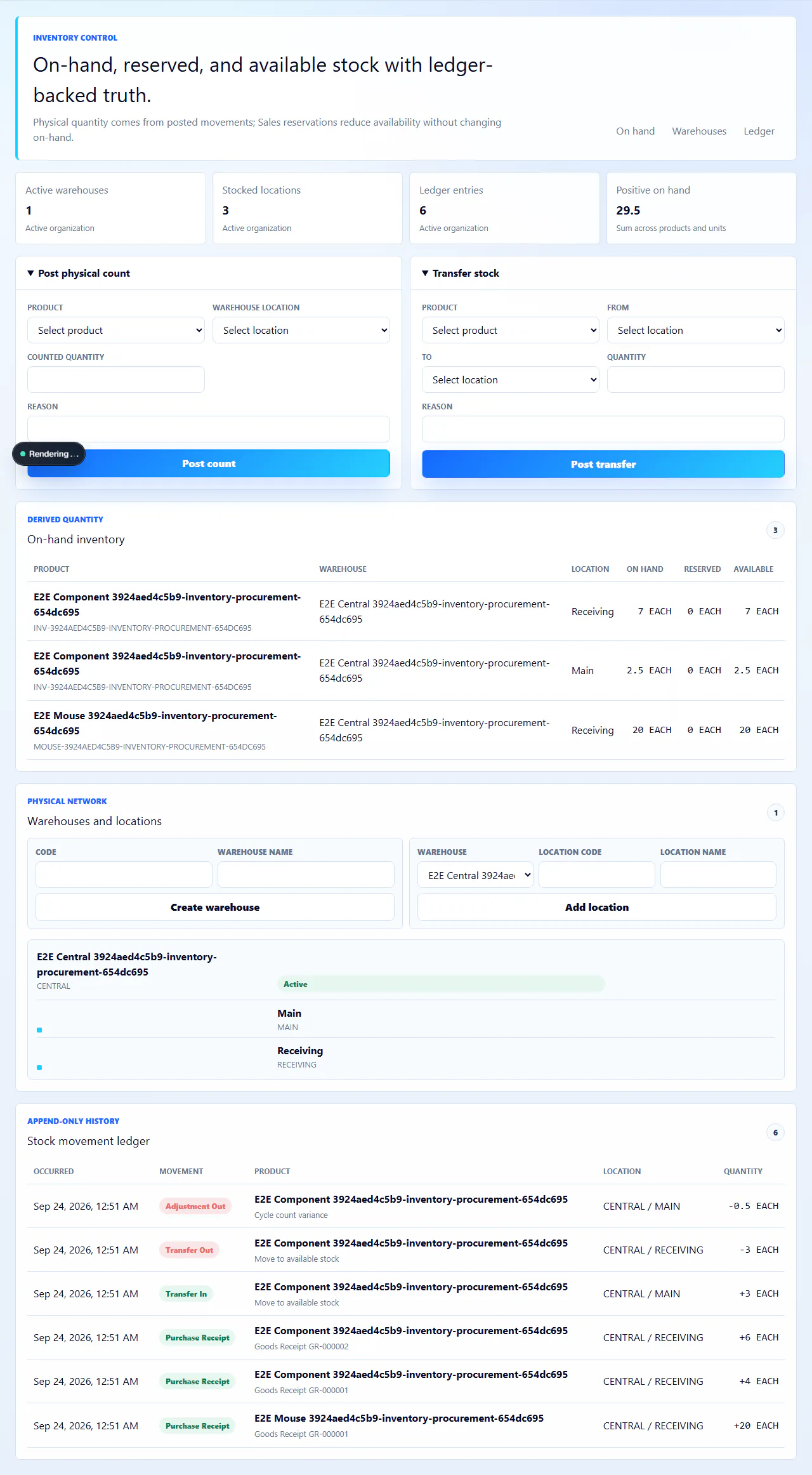
Receipts, issues, transfers, adjustments, reservations, releases, and completed sales answer different questions. A movement ledger records what changed, where, when, why, and which source event caused it. Replacing that history with editable balance fields removes the evidence needed to explain a discrepancy.
Movement creation should be idempotent when it follows another workflow. If the same goods receipt or completed sale is submitted twice, the stock consequence should not double. Concurrency controls also matter when two workers act against the same available quantity. The system needs an authoritative outcome, not two locally plausible screens.
| Movement context | Operational meaning | Expected source |
|---|---|---|
| Purchase receipt | Accepted inbound quantity | Goods receipt |
| Sales reservation | Quantity committed but not yet moved | Sales order |
| POS issue | Quantity sold through a completed receipt | POS receipt |
| Transfer | Quantity moved between controlled locations | Transfer record |
| Adjustment | Count or correction with an approved reason | Adjustment event |
04
Distinguish on-hand, reserved, and available
On-hand quantity describes what the movement ledger says is physically held. Reserved quantity describes supported commitments against that stock. Available quantity is the remainder that the organization can promise under its reservation rules. Showing only one of these numbers invites either overselling or unnecessary refusal of valid demand.
Define when a reservation is created, released, consumed, or expired. Tie each reservation to the order or workflow that owns it. A manual adjustment should not quietly erase another team’s commitment. When a reservation fails, the operation should fail clearly and leave prior state intact.
05
Reconcile from source to balance and back
Periodic review should compare balance summaries with movement history and supported physical counts. Investigate unexplained adjustments, negative availability, stale reservations, and movements with missing source context. The objective is not merely to make the total match; it is to understand which process created the difference.
Zivanox organizes warehouses, locations, units, movements, reservations, and availability within the same tenant-scoped operating context used by Sales, Procurement, and POS. It does not claim manufacturing planning, shipping-carrier execution, barcode hardware, or every warehouse discipline. Those boundaries should be evaluated separately where needed.
Assign each recurring exception to an operational owner and a source workflow. Procurement should investigate quantity received against purchase commitments, Sales should review reservations that no longer match an active order, POS should reconcile completed receipts to issues, and warehouse operators should explain adjustments or counts. A shared exception queue is useful only when the team also defines evidence, approval, correction method, and closure criteria. That discipline turns stock review from a periodic total-fixing exercise into a process-improvement loop.
Editorial scope
This guide contains 699 words and reflects the implemented Zivanox product boundary reviewed on 2026-09-24. It does not replace professional, legal, tax, payroll, or jurisdiction-specific advice.
Evaluate the workflow
Bring your records, exceptions, and required controls.
Closed Beta access begins with a bounded workflow review, not an open signup or automated purchase.
Request Closed Beta Access