
Sales & CRM
Sales order workflow: from accepted terms to accountable fulfillment
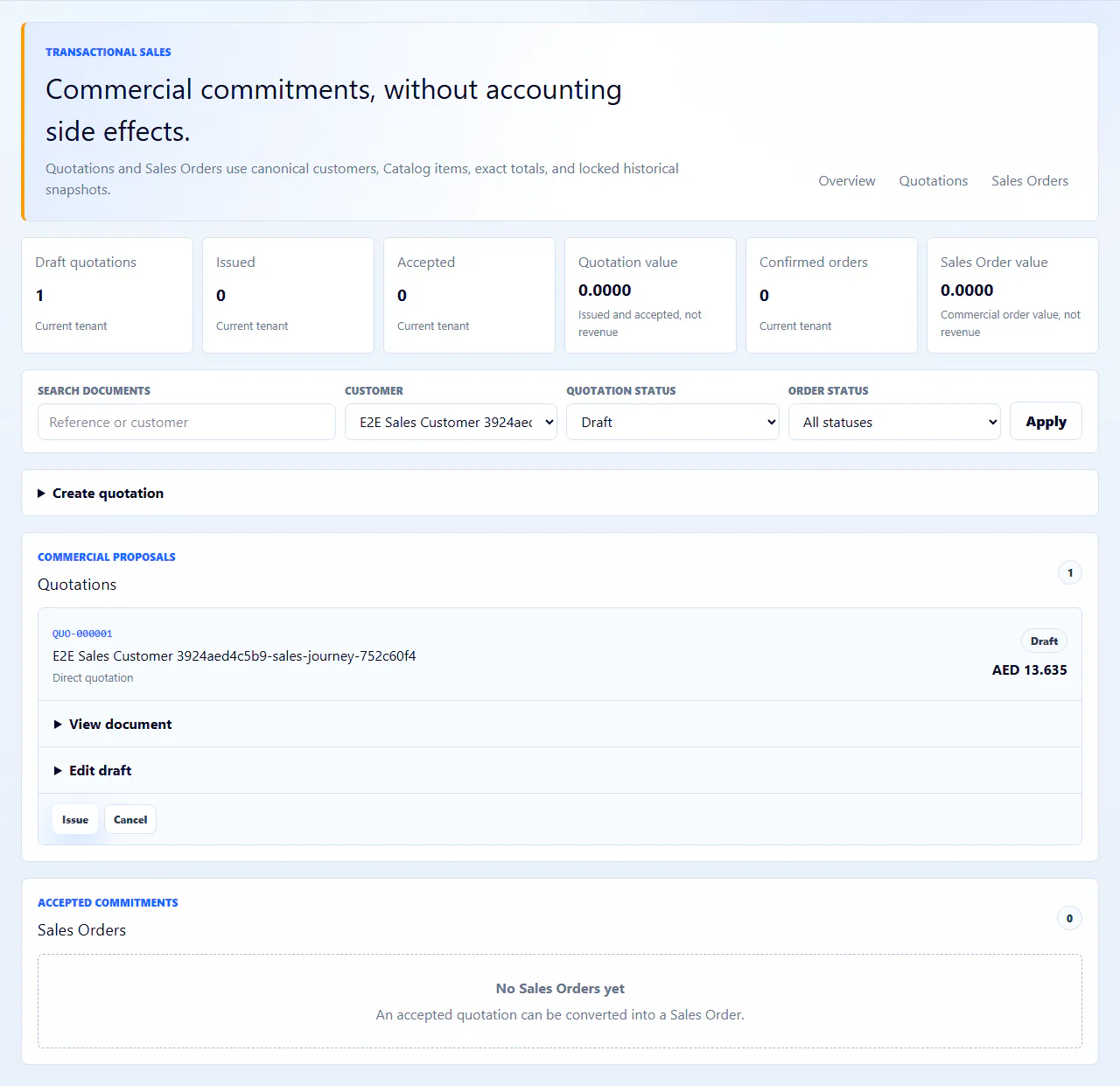
A sales order should carry an accepted commercial promise into operations without erasing the quotation, customer context, or product detail that created it.
Reader intent: Informational with commercial workflow evaluation
01
What a sales order is responsible for
A quotation presents proposed commercial terms. A sales order records the commitment the business intends to execute after those terms are accepted. Treating the two as the same document makes later questions harder: which version was issued, what did the buyer accept, and what is operations now expected to fulfill? A controlled workflow preserves both records and the transition between them.
The sales order should identify the customer, line items, units, quantities, prices, discounts, totals, dates, and current lifecycle state. It should not silently rewrite the accepted quotation when a product or customer record changes later. Durable snapshots make the commercial promise reviewable without freezing the canonical customer or catalog forever.
- Keep quotation and sales-order identities separate.
- Preserve issued and accepted commercial snapshots.
- Record who performed each lifecycle transition.
- Use deterministic decimal totals rather than display-only arithmetic.
02
A practical quote-to-order sequence
Start with customer and catalog context that has a clear owner. Build the quotation, validate its line calculations, and issue an identifiable version. Acceptance should be an explicit event, not an inference from an edited status label. Only then should the workflow create or confirm the sales order that downstream teams will execute.
The order can then carry demand into stock and fulfillment planning. That does not mean a sales order should directly mutate inventory without a defined movement or reservation event. It means the order becomes the source context for whichever governed inventory action the organization supports. The distinction protects both commercial and warehouse records.
| Stage | Primary question | Evidence to retain |
|---|---|---|
| Quotation | What are we proposing? | Version, lines, totals, customer snapshot |
| Acceptance | What was agreed? | Actor, time, accepted version |
| Sales order | What must operations execute? | Order identity, status, source quotation |
| Fulfillment | What moved or was delivered? | Reservation or movement source |
| Finance | What financial record followed? | Posting or receivable source context |
03
Where sales and inventory need a boundary
Sales needs availability context, but it should not own warehouse truth. Inventory needs confirmed demand context, but it should not reinterpret commercial terms. A reliable boundary lets Sales inspect on-hand, reserved, and available quantities while Inventory remains responsible for the movements and reservations that change those values.
This separation prevents a common failure mode: a quote appears fulfillable because it reads an on-hand number that ignores prior commitments. Available quantity should be derived from the organization’s supported reservation model, not improvised in the sales interface. When the order advances, the resulting reservation or movement should point back to its source.
04
Controls worth testing before rollout
Test the workflow with changed catalog data, repeated acceptance requests, concurrent actions, insufficient availability, and a user who lacks permission. Confirm that the accepted quotation remains stable, that duplicate requests do not create duplicate orders, and that cross-organization access fails closed.
Reconciliation should be possible in both directions. Starting from an order, reviewers should find its quotation and customer context. Starting from a stock movement or financial record, reviewers should be able to identify the operational source where the implemented workflow promises that relationship.
- Duplicate acceptance does not create a second order.
- Unauthorized state changes fail closed.
- Cross-tenant identifiers disclose no data.
- Stock and Finance records retain supported source references.
- Audit history identifies actor, action, and outcome.
05
How Zivanox approaches the workflow
Zivanox connects customer context, controlled quotations, sales orders, inventory context, and governed Finance records inside one tenant-scoped system. The product keeps lifecycle stages explicit and uses tested authorization and integrity boundaries around sensitive transitions.
That scope does not imply carrier booking, payment processing, or every possible fulfillment method. Evaluation should begin with the workflow your team actually runs, the record each group owns, and the evidence needed at every handoff.
Editorial scope
This guide contains 663 words and reflects the implemented Zivanox product boundary reviewed on 2026-09-24. It does not replace professional, legal, tax, payroll, or jurisdiction-specific advice.
Evaluate the workflow
Bring your records, exceptions, and required controls.
Closed Beta access begins with a bounded workflow review, not an open signup or automated purchase.
Request Closed Beta Access