
Sales & CRM
CRM pipeline management: stages, evidence, and the sales handoff
A pipeline should help a team decide what to do next. It should not turn uncertain opportunity value into booked revenue or hide the handoff into executable sales work.
Reader intent: Informational CRM process and software evaluation
01
Design stages around decisions
A useful pipeline stage represents a meaningful change in evidence or responsibility. Qualification may mean the organization has confirmed a real problem and an appropriate contact. Discovery may mean requirements and stakeholders are understood. Proposal may mean commercial terms have been issued. Names matter less than the decision rule that moves work forward.
Avoid adding stages merely to make a diagram look detailed. Too many ambiguous stages encourage individual interpretation and make reports difficult to compare. For each stage, define the evidence required, the owner, the next action, and the reason an opportunity may leave or close.
- Give every stage a decision rule.
- Require only information that supports the next action.
- Record close and loss outcomes explicitly.
- Keep expected value separate from booked revenue.
02
Keep leads, customers, and opportunities distinct
A lead is an unqualified prospecting record. A customer or canonical business party represents an established relationship identity. An opportunity represents a possible commercial outcome with its own stage, value context, owner, and activity. Collapsing all three into one editable contact record makes conversion history and reporting unreliable.
Controlled conversion should create or associate the canonical customer context without discarding the lead record. The opportunity can then retain the evidence collected during qualification. Duplicate conversion requests should not create duplicate customers or opportunities.
03
Use activities to drive work, not decorate the record
An activity should answer what follow-up is expected, who owns it, and when it matters. Notes can preserve context, but they should not substitute for a due action when the team needs accountability. Overdue and open activity views are useful only when completion state is maintained consistently.
Sensitive relationship notes should remain inside organization and permission boundaries. Search and reporting must not leak another tenant’s names, values, or activity counts. Access tests should include direct identifier attempts as well as normal navigation.
| Record | Purpose | Common mistake |
|---|---|---|
| Lead | Capture and qualify a potential relationship | Treating every import as a genuine prospect |
| Opportunity | Track a possible commercial outcome | Reporting expected value as booked revenue |
| Activity | Make the next action accountable | Using undated notes for required follow-up |
| Customer | Represent canonical business identity | Creating duplicates during conversion |
04
Define the CRM-to-Sales handoff
The handoff should occur when the team is ready to express controlled commercial terms, not merely when a pipeline stage changes color. Carry the canonical customer and relevant opportunity context into the quotation. Preserve the quotation as its own document with line-level terms and lifecycle history.
Once accepted, move the commercial commitment into the sales-order workflow. CRM can continue to explain the relationship and opportunity, while Sales becomes responsible for execution. This boundary keeps forecast, proposal, accepted terms, and booked operational records from becoming one ambiguous total.
05
How Zivanox approaches pipeline scope
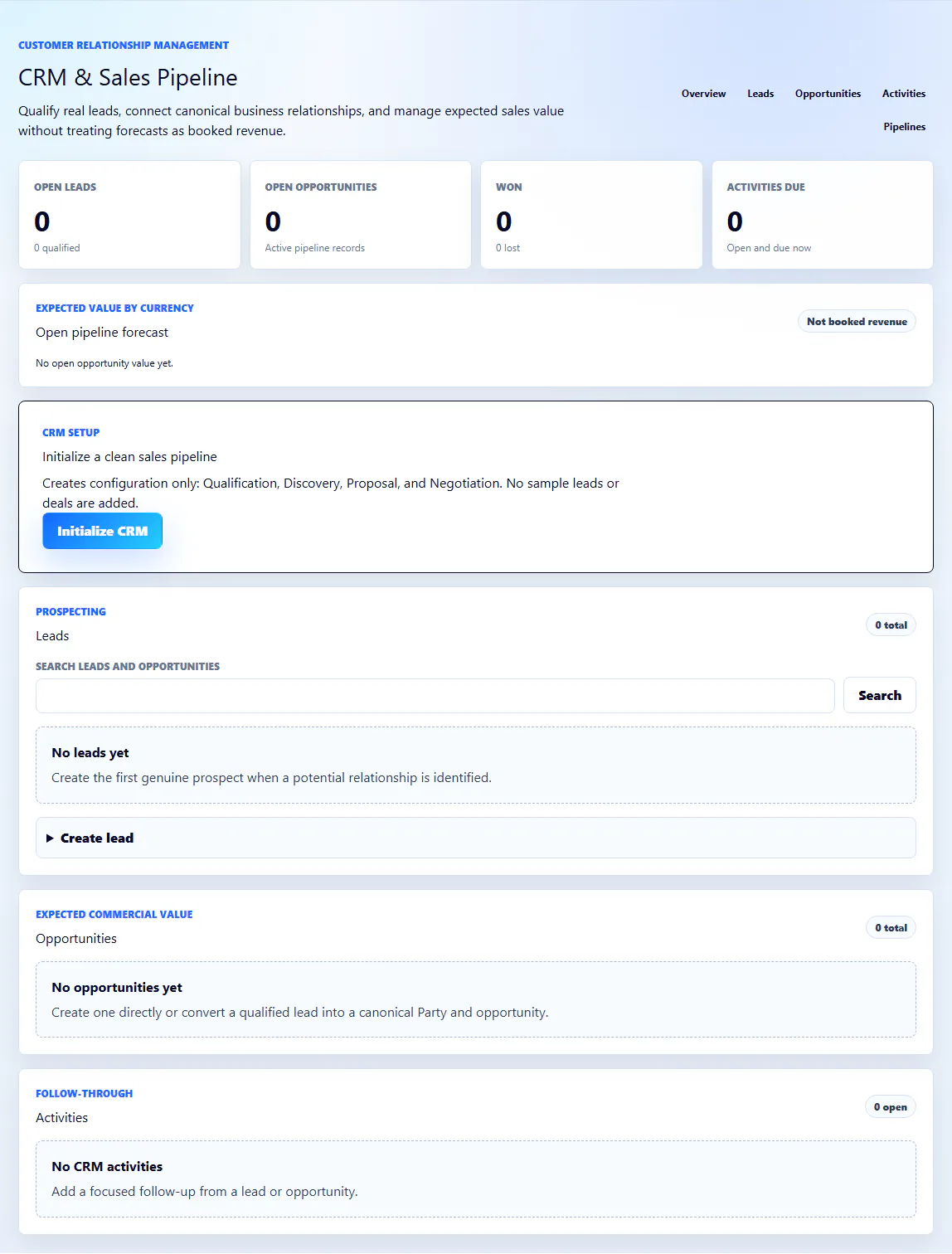
Zivanox supports lead progression, customer and party context, opportunities, activities, and the handoff into governed quotation and sales-order records. The application makes clear that open pipeline value is not booked revenue and keeps actions tenant- and permission-scoped.
The current claim does not include marketing campaigns, enrichment, bulk outreach, email sequencing, or predictive scoring. Teams that require those functions should evaluate them separately and define how verified records would enter the core CRM and Sales workflow.
A practical evaluation should use one synthetic prospect from first qualification through a quotation and accepted order. Review stage history, activity ownership, customer identity, duplicated-contact handling, rejected conversion, and the record available to operations after handoff. Then test a user without the required permission and an identifier from another tenant. This combines usability with the controls that matter once pipeline data becomes a commercial commitment rather than leaving security and downstream execution for a separate review.
Editorial scope
This guide contains 662 words and reflects the implemented Zivanox product boundary reviewed on 2026-09-24. It does not replace professional, legal, tax, payroll, or jurisdiction-specific advice.
Evaluate the workflow
Bring your records, exceptions, and required controls.
Closed Beta access begins with a bounded workflow review, not an open signup or automated purchase.
Request Closed Beta Access